Cascade 001 - 1984
A New Magazine for Europe
We're completely crazy! Not only are we co-organizing the 7th European Juggling Week for the past year, but we're also taking on the task of launching a European juggling magazine in Frankfurt.
But it all ties together closely:
We received so many enthusiastic letters and calls from jugglers all over Europe, each one different, each with a new idea, telling us about a performance, a tour, a theater meeting here and a juggling festival there (e.g., Covent Garden, Bremen, or Copenhagen). And they all shared the anticipation of meeting and exchanging ideas with other jugglers.
That's when the idea that had been floating around at the last juggling meeting in Laval came back to us: "It would be great if there were a juggling magazine for Europe, so we could stay in touch beyond the annual meetings and find out where jugglers are up to. Someone just needs to take it on." Okay. We'll do it.
And how do we envision it? We want to create a magazine for all jugglers in Europe, from beginners to professionals, regardless of whether they belong to an organization like the IJA or not. This immediately brings up the language issue, because a significant reason for a European magazine is that "Jugglers World" (besides only reporting on American events) is only published in English. Not every juggler can or wants to read an English magazine. So, the European magazine will initially be published in English and German. (Hopefully, the authors will agree to our free translation!)
We would have liked to publish the first issue in French as well, but unfortunately, that failed due to a lack of "juggling-specific" language skills and time. Perhaps someone will volunteer to translate the next issues into French?! Maybe there's also a need and translators for other languages?
In terms of content, we've thought about the following: We want to feature juggling groups and individual jugglers, how they got into juggling, what they particularly enjoy about it, their ideas and dreams related to juggling... We want to write about performance experiences across Europe (on the street, in theaters, under the circus tent...) and share anecdotes from the road. It would be good to also include "reviews" of shows seen, juggling books, etc.
Furthermore, we'd like to establish sections such as: Instructions for prop building, language tips for international tours, extra hobbies (magic...), tips and tricks (e.g., we're looking for someone to write a regular workshop page), event calendar (festivals, performances, group meetings...), and classified ads (looking for tour partners, clubs to give away...).
Of course, we can't and don't want to write all these articles ourselves. We see ourselves more as a collection point, "layout artists," and publishers. The two of us can't be everywhere in Europe at once, but all of you together can!
Therefore, we ask you to send us articles and good pictures, about all the events and stories you've experienced, and to send us all the information and dates that are remotely or concretely related to juggling. We would love to have a permanent "correspondent" and contact person in each country, so it can truly become a European magazine.
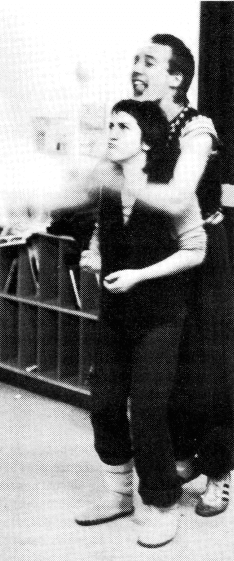
Jugglers
With these ideas, we approached several jugglers and juggling groups, who then helped us make this first issue possible with articles, information, ideas, ads, and kind letters. Many, many thanks to everyone.
The last point is financing. The magazine will initially be published quarterly. Since we need to plan the print run in advance and cannot take on significant financial risk ourselves, the magazine will only be available via subscription and prepayment. (Anyone wanting multiple copies for, e.g., retail sales, should contact us directly.)
The price is calculated to cover costs, meaning paper, Letraset, postage, copies, photos, and especially printing – our working time is, of course, excluded.
So, please take an subscription slip, fill it out, and bring it to us or send it by mail if you can't find us at the meeting. We would, of course, be thrilled to receive ad customers and especially donations!
We hope you like our idea and look forward to your suggestions and criticism, and to compiling the next issue with your articles. Enjoy reading.
Gabi & Paul
Circus Wanted!
A Report from Two Clowns Who No Longer Wanted to Live in the GDR
Circus Wanted!
By Streuselschnecke...
How did the whole circus thing start? Well, that's almost an endless story....
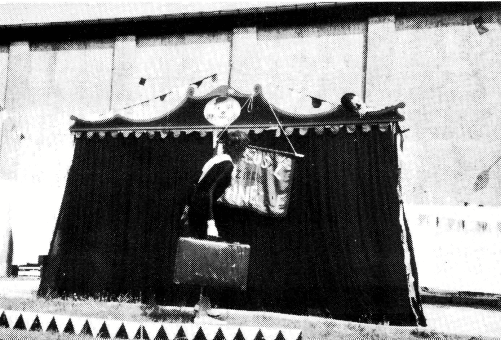
Uli loved the smell of fresh wood, became a carpenter, joined the circus as a handyman, and started juggling. Kattrin didn't know any better and studied acting. Uli came back to Berlin and wanted to show his skills at a party. However, he drank too much out of nervousness, and the balls did whatever they wanted with him. That's how we met, and Uli became Kattrin's juggling teacher.
That was in February 1980, and we soon discovered our shared flair for comedy. In the fall, we had our first performance under the name ULK. (The first letters of Uli and Kattrin).
But it wasn't funny at all, rather embarrassing. But every beginning is difficult; we kept practicing: tap dancing, juggling, mime... Since there are no workshops in the GDR, we relied on private support.
In the summer of 1981, Kattrin finished her studies and had to go to a theater for three years as a graduate. That's how the law dictated, otherwise, she wouldn't have received her degree. And without a degree, you're nothing in the GDR. This means: no matter how good someone is, or what they can do, without a state-issued degree, they are not allowed to perform, and therefore not work in their field. And those who don't work are considered anti-social, and those who are anti-social get locked up.
But you mustn't think that this means there's no initiative: on the contrary, necessity is the mother of invention. Readings, exhibitions, concerts, and theater programs take place in studios, attics, and apartments. Performing simply on the street is forbidden, but some still do it, even though they face heavy fines.
But back to us. Kattrin went to the theater, but after half a year, the graduate contract had to be terminated for health reasons. She returned to Berlin, and we tried a clown program for children, built props, and our stage.
While Kattrin was working at the theater, Uli had trained our dog Cato (a purebred English Pointer). Cato became our circus lion.
Kattrin applied for her performance permit from the city council, which she received without problems due to her completed acting studies. Since Uli had nothing comparable to show, he actually shouldn't have been allowed to perform at all. So, he became Kattrin's "assistant." Due to the excessive bureaucracy of the permit system, this went unnoticed.
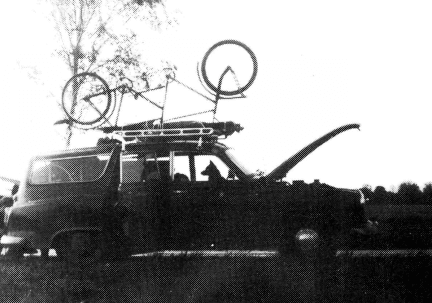
The same applied to Clemens, who became our technician. (He is unfortunately still waiting for his emigration.) Clemens had a car; well, "car" is probably an exaggeration: it was called Herbert, was older than us, and was essentially a total wreck. But, thank God, it only ever broke down on the way back. A faithful vehicle. We kept the tandem bike with us for all emergencies until it was stolen.
Now we wanted to advertise our program. You need to know that there are no photocopiers in the GDR. You also can't just get things printed easily. We would have first had to get our name "Kinderzirkus Streuselschnecke" (Children's Circus Sprinkle Snail) officially approved. We didn't feel like doing that either. So, we wrote everything by hand and decorated the cards with a colorful paper clown. It was tedious, but it was fun.
We received many offers because we were unique in our way in the GDR, and because our simplicity, humor, and playfulness offered an alternative to state-sponsored entertainment.
... to Pusteblume
A year later, when we presented our program to the state concert and guest performance agency to get a group classification so that Uli would be recognized as Kattrin's partner, the commission stated that our program lacked educational value.
So, we received nothing and continued to muddle through, always knowing that it could be discovered that Uli wasn't allowed to perform at all. (It came out two weeks before we emigrated.)
In the summer of '83, when we wanted to perform at a church peace festival, a cultural official advised us against it, warning that otherwise, we would receive a performance ban for the entire GDR.
Incidents of a similar nature made it increasingly clear to us that we were reaching the limits of what was possible for our work and our plans. Therefore, we had to and wanted to leave the GDR sooner or later.
We've been living here since March. We are in the process of building up a new program for children. We are no longer called Streuselschnecke, as this pastry isn't known here, but "Kinderzirkus Pusteblume" (Children's Circus Dandelion).
Our deep dream is to found a circus in a few years, where kind and funny people will participate. But unfortunately, the money for this dream is lacking. It would be a shame if it failed because of that.
Therefore, it would be wonderful if you could help make this dream come true by transferring a little money to our specially set-up account:
Bank code: 42060021
Volksbank Gelsenkirchen)
Account number: 518.503.240
Even if it's just one Mark, because every little bit counts towards building a circus.
Thank you very much, and if you're more interested in this project, or want to know something about Kinderzirkus Pusteblume, please write to:
Kattrin Kupke & Uli Zschau
Arminstr.10
4650 Gelsenkirchen
Tel.:0209/27 16 42
So, see you soon, or maybe not.
Kattrin & Uli
A Smile Defies Gravity
Letter from Toby Philpott, European Director of the IJA
A Smile Defies Gravity
For two years now, I've held the title "European Director of the International Jugglers Association" (IJA). It's a title W.C. Fields would have loved, as it sounds so important and mysterious (and means almost nothing). I don't "direct" anyone and spend most of my time in England.
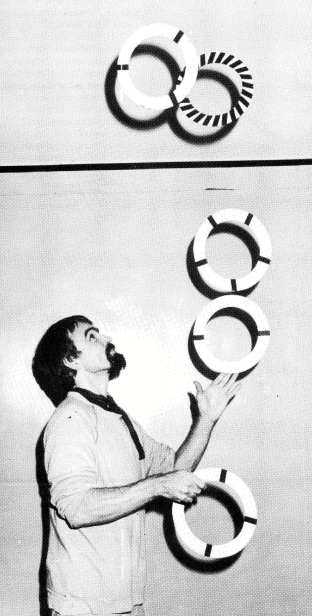
The IJA started as a small group of friends and is now a large organization with hundreds of members in America. The first European juggling meeting also consisted of just a small group of friends in England, but it was the first step in justifying the word "International." Today, this meeting attracts people from over ten different countries.
The meetings are getting bigger, and many non-members attend. Most of them see no reason to join the IJA if the only thing they get out of it is an American magazine and a mailing list they'll never use.
I can understand that. If the IJA didn't exist, I would still love to meet other jugglers (not just the people who learned from me), I would want to know where to buy props, where to see shows, where to perform on the street. I would still want to share ideas and see people who juggle better than myself. I was able to do most of that before I heard of the IJA, but I've seen and done more since we started organizing meetings in Europe. These meetings are the best reason to have an official organization. It's not a union, and we can't arrange performances or even guarantee friendships.
I believe that Europe should have a representative on the American IJA board, who maintains contact with the long-standing members in the States and other countries, and who should start making the organization truly international.
When I enter the hall of a juggling meeting, I see two fundamental types of people. Some are practicing, sweating, and perfecting techniques, pushing their own limits. I call these the Olympians, to emphasize this pursuit of perfection, athletic spirit, and a touch of Greek gods and goddesses – superheroes.
Others have come to play; they laugh and joke, experiment, improvise, exchange ideas, and have fun. I call them the "Traveling Players," and they are the ordinary mortals, the jesters, who use their improvisational skills as all travelers and players must.
You might think that someone with a title like "European Director" would be an "Olympian." Actually, I started juggling as a lark during a lazy phase of my life. Now I have several years as a performer and teacher behind me, but I always want to convey the fun of it; I don't expect a gold medal.
We need the heroes and the clowns. The Olympians can show us what is possible with dedication; they set new standards, and they themselves can enjoy an audience that truly appreciates the work that goes into every single movement.
The Traveling Players are the ones who bring new people in, help new jugglers get started, spread the word, and entertain.
You will be reading this in a magazine initiated by two Germans who would like to see more Europeans in the IJA.
I'm writing this as a letter because I'm not a journalist, and I make my mistakes in public, as usual. If you want this magazine to continue, please write to the magazine's editors or send photos. If you want Europe to play a more significant role in the IJA, write to me, and I will try to explain our position to the other board members. If you'd rather have an independent European group, then go ahead and start one. I think it would be a shame to completely split from an organization that has existed for 37 years and has members in many countries.
By the way, if you think a real Olympian would be a better spokesperson for Europe, you can run yourself, or find a juggling politician to be our representative for 1985.
In the meantime, I hope to see you during our few days together. And don't forget: A smile defies gravity. (That's a good slogan to win an election, or to give our translators headaches.)
Autonomous Juggling Group Wiesbaden and the 7th European Juggling Week
Gravity - So What!
Gravity - So What!
The autonomous juggling group SCHWERKRAFT NA UND! (Gravity - So What!) from Wiesbaden, or rather the Rhine-Main region, has only existed for a relatively short time.
As late as August 1982, there were only a few jugglers in Wiesbaden who hardly knew each other. By chance, the three original members, Paul, Uli, and Christoph, came together, juggled in Wiesbaden's parks, and decided a few weeks later to travel to the 5th European Juggling Meeting in Copenhagen.
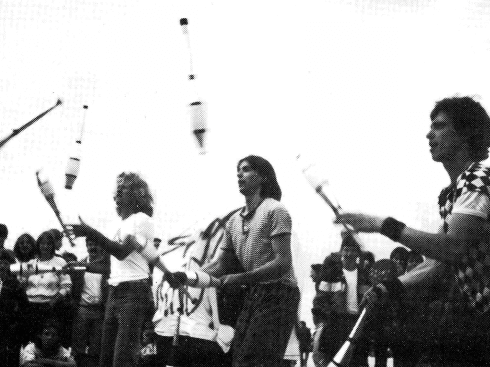
Fritz from Frankfurt came along. Following the motto: "Only what you do gets done," and impressed by the Copenhagen meeting, Fritz wanted to organize the 6th European Meeting in Frankfurt. He lost the vote in Copenhagen with his spontaneous idea to the better-prepared jugglers from France.
Paul and Christoph, still buzzing with the enthusiasm of what they had experienced in Copenhagen over the last three days, stood thoughtfully but full of ideas on the railing of the ferry back to Germany. The founding of the autonomous juggling group schwerkraft-na und! began here.
Since then, the jugglers have met every Thursday from 5:00 PM to 10:00 PM, in Nero Park during the summer and in the Haus der Jugend (House of Youth) during the winter, a space provided by the Wiesbaden city youth welfare office.
The group grew to 20 people in a very short time.
New faces every week, but also people were missed every week who were never seen at the club again. A core group of 10-15 people has now emerged.
The open nature of the group and its organization based on the principle of "as you please" makes it extremely difficult to effectively translate the collective potential into performance concepts. Despite jointly acquired juggling equipment, such as 14 unicycles, clubs, rings, rola-bolas, devil sticks, etc., and a relatively high standard of skill, the juggling techniques of individuals differ considerably, leading to the formation of several more established small groups, such as JOMIPO-Luftiko, Werner WAHNSINN & Christoph CHAOS, Katinka, and the Flea Juggling, etc.
The differing skill levels and varied performance concepts of these groups make it difficult for new beginners who join the autonomous juggling group to be integrated, while individual performers find it easier.
This development has often been discussed within the club, but no concrete steps have been taken to change it so far.
Nevertheless, joint performances take place on various occasions. The group has performed at street festivals, during holiday programs and festivals, at weddings, in youth centers, and schools. We also performed at "Artists for Peace" in Darmstadt in May 1983, did a television show with Südwestfunk, and performed as part of the Berlin Summer Night's Dream at André Heller's "Greatest Fire Theater of the Century" in July 1984.
Meanwhile, Fritz's idea of organizing a European juggling meeting matured.
During negotiations with the city of Frankfurt, we achieved that a large part of the hall rental for the Volksbildungsheim (Community Education Center) was covered.
The central location of the venue in the city center and the allure of "world city Frankfurt" were decisive factors at the business meeting in Laval to host the 7th European Juggling Week in Frankfurt.
Since that date, we have made it our mission to make the next meeting even more colorful, more varied, and above all, more publicly visible. Fritz's original, wild idea was to arrange a spectacular meeting culminating in a fire juggling performance, with 500 jugglers and their 1500 fire clubs to the intoxicating rhythms of a rock band in front of the prestigious and ornate Frankfurt Opera House under the glow of the full moon.
It is intended to be an opportunity to shake up the flair of the banking and business city for at least 4 days, to bring fantasy into the street canyons, into the concrete. To bring a different feeling for life to the city's inhabitants, to make them smile or even laugh. "Chaos is announced. It's going to be turbulent. It will be colorful." (Frankfurter Rundschau)
We discussed the question of how to plan such ideas for a long time. Many planned actions failed due to the practices of the city authorities, but this should not prevent spontaneous ideas from jugglers.
At the same time, the importance of disseminating these ideas through all media was discussed. The conflict between publication and the perhaps justified fear of exploitation and commercialization of our fantasies, ideas, and skills by the media led to a film project failing.
We had no objection to mere reporting by the press, radio, and television.
A press release was sent to dpa and all major national and local newspapers. On September 1st, we drew attention to the spectacle of juggling with a juggling and poster campaign in Frankfurt's shopping streets, and on September 10th, with a press juggling show poster wall spray action conference, unusual for Frankfurt, highlighting the juggling spectacle.
The feasibility of all ideas must also be guided by the event's aspirations. Many jugglers come to meet their juggling friends from all over Europe, to exchange experiences, and to experience a different feeling for life with like-minded people without being under pressure to convey this feeling to others themselves. They also meet to be among themselves a little. This aspiration is certainly not arrogant or anti-publicity, as many spend the whole year performing for others' sense of life.
However, the organization of all other, less visible but usually important points also had to be resolved:
Do we have enough sleeping places? Who will provide food? How will the public show be organized? How will we divide the cash and ticket desk duties? Where will we get posters printed? Obtain official permits for every fart released or intended before, during, and after juggling week. etc...
All in all, organizing the 7th European Juggling Week was fun for us, and we hope that all jugglers and other participants feel the same way and will remember Frankfurt 1984 with good feelings and return home with new impulses and ideas.
Christoph Schmitt
KASKADE Workshop
The Pillar Page
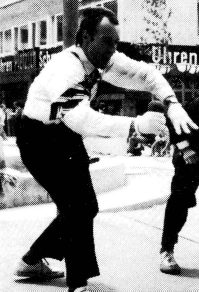
Dr. P. Luftiko (see picture)
O.K. You can now juggle 2 balls in one hand, with your left as well as your right. You could try 4 now. But wait a bit! There are hundreds of ways to use this skill with 3 balls in the "pillar" form that would amaze your friends and make your audience roar.
The basic "pillar" form: 2 balls thrown in the right hand parallel to each other (i.e., not in a circle), while the left hand throws the 3rd in the same rhythm as the right hand throws the outer ball.
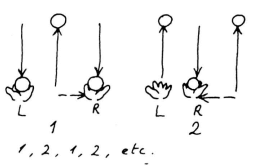
With this basic rhythm, you can vary this theme infinitely through small changes. You can alter the trajectories and switch the hand you're juggling the 2 balls with.
In the following descriptions, the terms "single (ball)" and "double (balls)" refer to the trajectories and not the number of balls in each hand. This means that in the basic form, the single ball bounces in the middle and the double balls bounce on the outside.
Tennis
Initially, the single ball is thrown high to the far right,
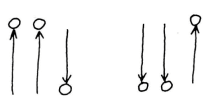
then it flies in a high arc to the left and back again, always back and forth. The trajectories look like this:
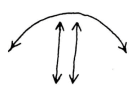
The double balls form the "net" (you could perhaps make tennis racket sounds or imitate John McEnroe!).
Hurdles
The beginning is similar to tennis, only this time the single ball makes an intermediate landing in the middle.
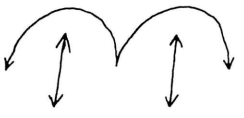
Each of the two double balls represents a hurdle. (If you say "boing" with each landing of the single ball, the audience gets the impression that the ball is bouncing.)
Crossing
Of course, you can also do tricks with the double balls. Here they cross each other.
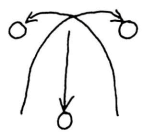
Although you've taken the precaution of throwing one double ball slightly higher than the other, you'll often find that they collide in the middle and fly away uncontrollably. Don't worry! With practice, you'll manage this collision intentionally without the 2 balls escaping in different directions out of your reach.
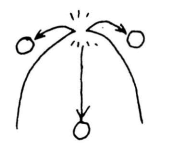
The higher the collision, the more enthusiastic the audience.
Crossed Arms
Try to catch the right double ball with your left hand and simultaneously the left double ball with your right. Catching is usually not too difficult, but then throwing them vertically upwards...!! Practice only with the double balls until this works before you add the single ball back in.
Shoulder Throws
(for advanced jugglers!)
Instead of simply throwing the double balls vertically upwards, throw them over your shoulders from behind, the right hand over the right shoulder and the left over the left. If you haven't warmed up properly, you'll dislocate your shoulders. If the double balls cross above your head against your will, then you seem to have the same problem as me!
Cheating!
If you have phosphorescent balls that glow in the dark, you can give the audience the impression that you are doing the pillar form. Suddenly, one of the double balls (the one you're holding) unbelievably stops in mid-air and refuses to come down. (You're simply holding it up, but the audience doesn't see that!) The rogue ball, which has seemingly defied the laws of gravity, can now perform amazing acrobatic tricks before rejoining the pattern. For example:
The Yo-Yo
You hold the "cheat ball" a few centimeters above one of the bouncing balls. Move your hand up and down; so that the distance between the held and the flying ball remains constant. It looks as if the balls are tied together with a string.
The Pendulum
This is also a yo-yo trick where the hands alternate while holding a cheat ball. A single ball bounces vertically up and down in the middle, while the cheat balls seemingly "pull" back and forth, and your arms make swinging pendulum motions. (You could also swing your legs alternately or say "tick-tock.")
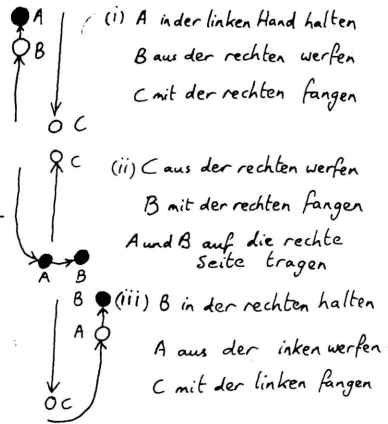
Image Transcript
(i) Hold A in the left hand
Throw B from the right
Catch with the right
(ii) Throw C from the right
Catch B with the right
Carry A and B to the right side
(iii) Hold B in the right hand
Throw A from the left
Catch C with the left
Here are some even more rebellious tricks for a cheat ball:
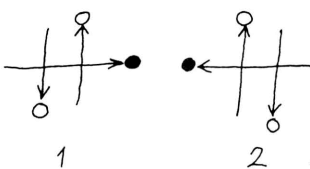
The Scythe
The cheat ball shoots horizontally back and forth between the two thrown balls, first over the descending one, then under the ascending one. The hand holding the cheat ball "cuts" through the 2-ball juggling like a scythe.
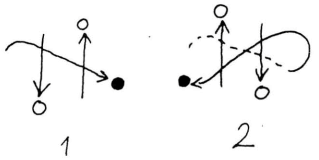
A graceful (and easier) variation is the "infinite scythe." The cheat ball doesn't describe a straight horizontal line but an infinity symbol (or a lying eight).
Orbit
A particularly rebellious cheat ball might start circling your head like an annoying fly. (Buzz, buzz!)
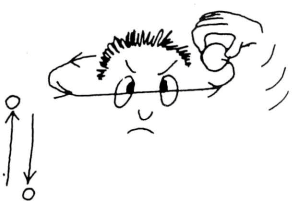
Since you're actually only juggling 2 balls and just holding the third, the number of tricks this third ball can perform is limited only by your anatomy!