Cascade 002 - 1984
JUGGLING WEEK '84
Idle Thoughts on Frankfurt from Someone Who Was There
400 this time, folks. The 7th European Juggling Convention in Frankfurt was the biggest yet, proving that at least as far as juggling on this side of the Atlantic is concerned, the only way is up.
But there was something more important than numbers this year; there was a feeling that the second weekend in September will always be the time when jugglers from all over Europe put everything else aside to be together.
That's why such meetings exist: Fifty-one weeks of the year, Europe's jugglers are spread far and wide, in groups of 3, 4, or 5, but mostly they are alone in their own little corners, inventing, practicing, working. They hardly ever, if at all, have the opportunity to exchange their ideas and tricks. Rarely do they have the chance to share what they have.
Then September approached, and the juggler migration began slowly. The signs were only visible to those making the same journey: club handles peeking out of backpacks (normal people wondered why anyone would carry 3 squash rackets); a bowler hat on a head that clearly belonged to neither an accountant nor an Englishman; a camper van illegally parked on a sidewalk, with a note on the windshield, "Where are you all?"
So it began, scattered and loose. But that quickly changed, and by 6 PM on Wednesday evening, the official start of this year's convention, the juggler invasion had reached its peak. The room designated for the welcome party could barely hold all the arrivals.
Some started juggling immediately, but most sat there with their mouths open, wondering, "Where do they all come from?" There were 400 answers to that.
And for those who juggle alone for most of the year, or who were at such a meeting for the first time, it was a huge shock. Who do you watch first? How did he do that? Where did that thing come from? Overload!
And they still had four overloaded days ahead of them!
Todd Strong and Andrew Allen's talent with diabolo and devil sticks proved that juggling isn't just about clubs and balls, although Antonio Bucci and his 7 balls were exemplary.
Tim Bat's hilarious yo-yo routine resulted in disappointment for everyone who wanted to buy a Duncan on Sunday; all yo-yos were sold out.
Gérard Estrem with his devil stick, Klapp's Kalli's Keulen Kompany's hat routine, the list could go on and on, and I apologize to all 390 people I didn't mention. It is enough to say that every person present showed something new to learn, and that the convention itself was a source of information for anyone who wanted to spend an hour on the balcony overlooking the hall.
And the public show?
Absolutely the best public show ever presented at a European convention.
The acts were varied, entertaining, tailored to the public, and ran very smoothly. Special thanks go to Paul Keast and Uli Meister, the unbeatable duo who announced the entire show professionally, humorously, and in three languages.
The public show is an important element of juggling conventions, a kind of open door that allows the public to see for themselves that we are not just a bunch of traveling gypsies who steal babies and disturb public order, but that we are instead a very talented group of very independent people.
Mimes, musicians, comedians, acrobats, jugglers, and all-around nice people who would only plunder a city if it were in the contract.
This year's public show was a success in this regard, giving the city of Frankfurt two hours of enchantment, while at the same time giving all the jugglers a chance to applaud each other. Thanks again to all the show organizers for this good work.
And again, an apology for not listing every participant in the public show, number by number; that is done by others, and besides, I could never do them all justice.
Nor can I do justice to the convention itself. My real intention with the article was to convey the feeling of the event, the sense of belonging, the camaraderie, all of that, the element that connects each convention with the next and is the reason people return in ever-increasing numbers each year. It's not just the juggling, but it's something else, and no one who wasn't there themselves can be expected to understand what it is!
But what it is, in all its simplicity, is this:
The conventions are always fun. All the philosophy and profundity you can imagine can never summarize the conventions as well as this one word can. Fun is what makes the juggling festival, because juggling is fun and should always be fun.
Many thanks to the Autonomous Juggling Group. With their games, their organization, and their hard work, they have managed to preserve the feeling and gave everyone present a good reason to meet again next year in Louvain-La-Neuve, Belgium.
Jobik LaCombe
Since most of our readers were at the juggling convention themselves, it's probably unnecessary to give a full report.
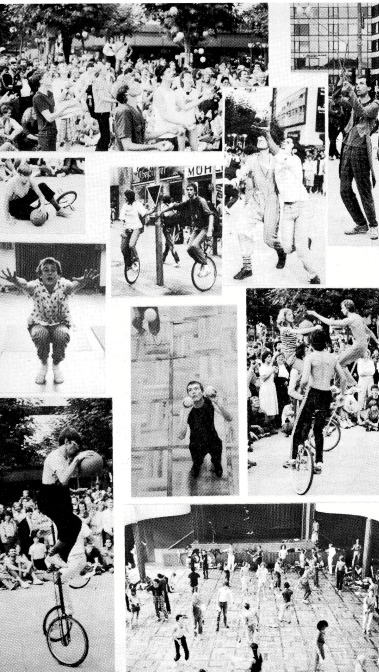
As Jobik writes, you can't really appreciate what happened there without having been there anyway. Instead, we've collected some photos that might remind you of many things, and gathered some information that you might have missed.
Did you know, for example, that some of it was broadcast on television? On Friday, there was a short report on the competitions in the Heute Journal, and later they showed more of it in Aspekte. In Hessenschau, they also showed some scenes (with terrible commentary), which probably helped fill the Volksbildungsheim for the evening show. (That was the TV crew who had set up with blinding spotlights.) And perhaps most surprisingly, a short film with an interview from ABC News was broadcast to the States. (A longer film about Fritz Brehm, containing many festival scenes, will likely be shown on ZDF in the spring.)
For those who hadn't recovered from the party by the business meeting on Sunday, here are the most important decisions again: It was unanimously decided that the convention next year will be near Brussels, with the support of the city.
It was also announced that the 10th convention will take place in the city of the 1st European Juggling Festival, in Brighton, on the south coast of England.
Toby Philpott was re-elected European Organizer unanimously.
It was announced that due to the many participants, the expenses could be covered and "Kaskade" could receive a subsidy for the 1st year. The rest goes – as is tradition – to the organizers of the next convention.
Although most seemed very satisfied with the festival, the course of the workshops was criticized somewhat. Despite their brilliance and entertainment value, they were more demonstrations than workshops, in the sense that participants worked on improving their techniques themselves. Perhaps the organizers and workshop leaders can think about this for next year.
If you didn't see it, the winners of the competitions received a pocket juggling set of 3 colorful beads (balls), Sorry pieces (clubs), washers (rings), and matches (fire clubs), all packed in a matchbox.
Gala
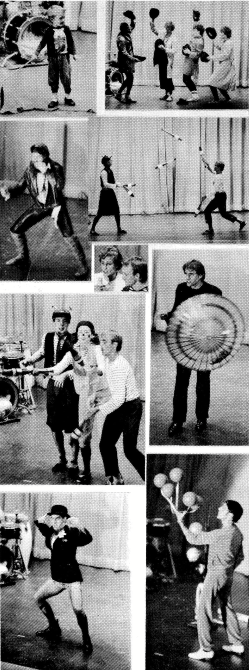
If you don't remember exactly what was so good about the public show, here's a brief rundown of the program:
STEVE MOCK from Amsterdam began the program with a classic 3-ball routine. The 2 FRÈRES PAMPELMOUSE from France showed very funny, acrobatic juggling.
TIM BAT from London yoyoed in and around his bowler hat, even though he forgot his pants. WERNER SCHREINER from Wiesbaden tried to juggle the world's smallest balls and lost them. ACHIM SCHLOTFELDT from Bremen rock'n rolled 3 clubs. Werner tried his hand with the world's largest club. J.J. (Gérard Estrem) from France was the clown who showed how prehistoric man discovered juggling. ALEX DANDRIDGE and MICK NOAKES from England threw clubs at giraffes. NEIL ROBINSON (currently in Germany) with his ribbon and Chinese rings magic was both fascinating and funny.
NARBO, the typical American tourist (from Paris), mistook Frankfurt for Amsterdam. SUMARAN from Wiesbaden wobbled around on 2 Rola Bolas. The INSTITUT FRANCAIS DE JONGLAGE beat everything with their lightning-fast club passing show. WON ISRAEL, an American mime, rode his motorcycle into nothingness.
After the break:
KLAPPS KALLI'S KEULEN KOMPANY from Hamburg did crazy things with hats. FRANCOIS CHOTARD'S ball-spinning act speaks for itself.
DAVID CRONIN and ANGELIKA GROSSE from Kassel presented a juggling workshop parody. LYNN THOMAS, assisted by DAVID PHILPOTT, whirled things over his Chinese umbrella. The SAKI CIRCUS gave a home game with a short 12-ball juggling routine. MARTIN SCHWIETZKE from Montpellier showed an absolutely perfect 5-ball routine that received the biggest applause of the evening.
BARRY ROSENBERG from the States and Henrik(?) from Denmark performed a funny routine with balls and bananas. SUE BROADWAY from Australia tossed straw hats around.
TODD STRONG played with his diabolo and, together with ANDREW ALLEN, showed the fastest devil stick tricks (both from America). SEM ABRAHAMS from Holland almost broke the stage when he rope-skipped on his unicycle.
MARCELINE KAHN from Barcelona showed very impressive fire club swinging. MAX and CHRIS from London and ACHIM from Bremen juggled fire clubs. Instead of an encore, COTTON spoiled us with a stage version of his Paris street show with balls and clubs.
Manuel Alvarez at Circus Roncalli
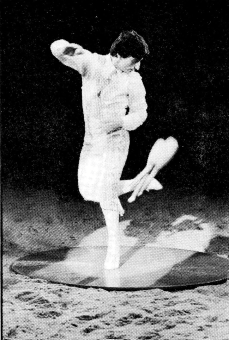
Alvarez at Roncalli – that's perfect footwork with clubs, presented at breakneck speed to Spanish music. He dynamically storms into the ring in a matador costume weighing over 6 kg and begins a fast-paced juggling of 7 rings.
After a brief change of props, the highlight of his act follows – a foot-focused 3-club juggling routine. With dancing skill, Manuel Alvarez demonstrates light-footed kick-ups, executed equally precisely with both the right and left foot, all while staying on a round wooden plate 2 meters in diameter!
Several times, he catches clubs thrown behind his back in the hollow of his knee, lets them slide to his foot, and then seamlessly reintegrates them into the juggling. At a breathtaking pace, the clubs whirl skillfully from hand to foot, foot to foot, foot to hand with a single rotation.
His specialty is the one-footed kick-up with 3 clubs simultaneously, where he catches two while the third is kicked up again with the same foot and immediately juggled further.
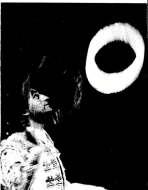
At the end of his performance, he sends eight plastic plates with boomerang-like flight characteristics soaring up to just below the tent's dome. However, the height of the circus tent is barely enough for this act, Alvarez explains.
We visited him in his trailer before the show and also met his wife and two young daughters. Over a cup of coffee, the 27-year-old, born in Seville, son of the famous Spanish artist family Alvarez, tells us that he was engaged with various circus companies in Africa for 8 years, later performed in Spain and France, and has been with Roncalli since the beginning of this year. His wife also comes from an old circus family, and they both really like the atmosphere at Circus Roncalli.
We learn from her that the two daughters are also already practicing the high art of acrobatics.
Alvarez's juggling clubs deserve special attention; he has never had to buy any, he proudly reports, but makes them himself from wood and cork.
The last issue of Kaskade mistakenly reported that not Manuel, but his uncle Pepito Alvarez, was performing at Roncalli, which we hereby expressly correct (We would like to apologize for this, Ed.).
We would like to thank Manuel Alvarez and his family again for their hospitality and wish him continued success.
Astrid and Jojo
VENUE: STREET
London - Covent Garden
For newcomers to street performing and for artists unfamiliar with the city, this column aims to provide some information about the performance scene in Europe, so you know what problems and opportunities exist in a city before you arrive.
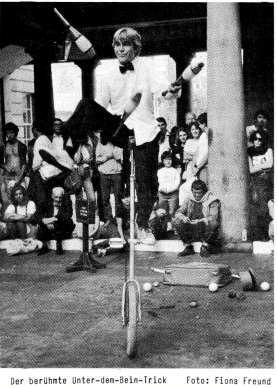
The famous under-the-leg trick
Photo: Fiona Freund
In London, the recognized center for street shows is Covent Garden. It's not only one of the busiest tourist areas, but street artists are also welcome (as long as they conform!). At first glance, the level of competition from magicians, musicians, acrobats, and of course other jugglers can seem quite daunting. But in reality, with only two legalized performance spots and thousands of visitors, it's almost impossible not to attract an audience for your show.
The two spots are organized by two different entities and have different rules. It's best to start with the West Piazza spot near St. Paul's Church. This is managed by Alternative Arts (Basement, 1-4 King Street, London WC 2, Tel.: 01-2), who issue a license for the performance of any act that is not racist, immoral, or otherwise offensive, regardless of the quality of the show. (A separate fire performance permit and certain safety precautions are required if you use fire.)
Getting a slot for a performance is, however, more difficult than getting permission. The day is divided into half-hour slots from 11:30 AM until dark, and you have to sign up on a list at the performance location for an available half-hour.
Since so many people want to perform, each person can only sign up once a day, and to be sure of getting a spot, you have to sign up before 8:00 AM in the summer. You also need to be at the piazza at 10:00 AM when any issues are discussed with employees from Alternative Arts.
The second spot is in the North Hall of the renovated market building; it is covered. It is managed by the Covent Garden Market Management (Unit 41, The Market, Covent Garden, London WC2, Tel.: 01-8369137). They insist on a stricter selection process and have greater restrictions; for example, fire is not allowed, and anything that could cause a mess (broken eggs, half-eaten apples) is banned. There is a "quiet time" between 3:00 PM and 5:00 PM, where amplified music and percussion instruments, etc., are not allowed. (Many regular performers use battery-powered amplifiers to play tapes, and this helps attract a crowd.)
Booking is also different: each group can book a maximum of 2 hours per week. Reservations are made every Monday at 2:30 PM for the following week. This can, of course, cause problems for artists who can only be in London for a short time.
Many performers have someone who goes around with the hat and collects donations ("bottler"), who generally receives a quarter of the earnings. There are usually "bottlers" available, and with so many spectators, it's often worth hiring one.
The fixed rules may take away some of the spontaneity that a street performer enjoys, but they ensure that everyone has a chance to perform without being pushed aside by another, louder, more experienced artist.
There are few established alternatives to Covent Garden for doing shows. The Barbican Complex welcomes street artists and can be a good spot around lunchtime (Tel.: Margot Landell 01-6384141), and Camden Lock market in North London (Camden Town tube station) can also be worth a try on Sunday afternoons.
If you need a change from London, the cathedral city of Canterbury has a good pedestrian zone and attracts many tourists, but fewer jugglers. Street shows are allowed and can be very lucrative.
I hope this article is useful for people who are thinking of coming to London sometime. Perhaps you could report on the street show situation in your city for the next issue of Kaskade?
Charlie Holland
A Little Anecdote from Rest-Berlin
As it lives and breathes, in the middle of Prussia
In the spring, we had trouble with the police quite often here – which street artist hasn't? They prohibited us, first politely, then insistently, from juggling with torches. Fire in the open air, who doesn't know how incredibly dangerous that is!!! Well, since we live here and want to perform here more often, we applied for a permit from the responsible authorities. But who is responsible?? For over two months, the back-and-forth from authority to authority took place; the civil engineering office, the fire department, various police departments, and the trade supervisory office marked the turning points of this obstacle course. The most entertaining part of the affair was an on-site inspection, not at the usual performance location, the Kurfürstendamm, where our tourist entertainment usually takes place, but on a huge, open space by the Wall, far from anything flammable. There, under the watchful eyes of 8(!) officials from various authorities, we had to juggle with our torches.
This all happened, of course, during usual office hours, i.e., in daylight, and anyone who knows how comparatively trivial torches appear in daylight won't be surprised that we finally received the permit. However, this was not without some conditions: we must carry a sturdy wooden box for our equipment (!?) as well as a woolen blanket to smother any excess flames on our or the audience's clothing, we must maintain a 3m distance from the audience, and finally, we must provide proof of sufficient liability insurance. All of this, however, only at specific, selected locations on the Kurfürstendamm.
It's a strange feeling to arrive at the place where you always perform and to know you have an official performance permit from the Police Commissioner and liability insurance with DM 1 million coverage.
However, no one should be afraid to juggle with torches in public here in Berlin. It is only recommended for those who want to perform on the street for a longer period not to juggle too high or – as we did back then – to have the torch tower (shoulder stand with 3 torches each) in the program, so that police patrols can see it from the street over the heads of the "masses." Friends of ours have had no difficulties whatsoever throughout the year in this way. In this spirit: "Fire away!"
Michael Genähr
(Image: A black and white photo of a street performer juggling fire torches.) #todo
Photo: Friedhelm Teicke
(Image: A black and white photo of a street performer juggling clubs.) #todo
Alex Dandridge in Covent Garden
Photo: Fiona Freund
"Does anyone have a lighter?"
(Image: A logo with juggling clubs, balls, and a unicycle.) #todo
JUGGLING - SPORT OR CULTURE?
GAME OR COMPETITION?
The theme that would dominate this issue soon became clear. Letters to "KASKADE" and reports from the U.S. Convention in "Jugglers World" discussed these two approaches to juggling. We are printing excerpts to spark a discussion.
Play Has History
Probably one of the most fascinating things about juggling is that it promotes the use of non-verbal brain functions. In adult education, I've noticed how office workers and students seem to find great relief from the "weight of words" when they juggle.
However, we need both forms of consciousness: the verbal, analytical one, and the one that allows us to grasp patterns and three-dimensionality. It's important to see the infinity (or figure-eight) shape and simultaneously maintain control over each individual object that describes it.
On a quiet beach, you might have skipped stones across the water, or aimed for a floating target, or improvised a game of "boules" with large round stones. When excavating an Old Saxon village (6th-7th century AD), a pile of small, perfectly round pebbles was found that are not found in that area, suggesting the ancient fascination with smooth spheres, with which a type of marble game might have been played here.
Although such games were certainly fun, people eventually tried to master the balls more precisely, so that the somewhat random boules developed into English "bowls," played on perfect, flat lawns, or into the flat snooker or pool table with symmetrical balls. This perfection left less room for error, and a clearer definition of playing surfaces and object dimensions led to more precise game rules, time limits, and scoring systems. This was not a negative development, as play can ultimately tolerate a degree of seriousness (rules, technique, competition) to an extent that the serious in world affairs cannot afford in terms of playfulness.
We also develop objects dedicated exclusively to play. For many such toys, a constantly repeating motion in itself is quite satisfying; I'm thinking of spinning tops, yo-yos, hula hoops, and frisbees.
While the oldest form of play (i.e., activities not directly related to survival) was probably dance, the next oldest was almost certainly the play with tools or weapons, as it appears in theater and martial arts in the Far East. Music and dance are similar to juggling in that the product is not something permanent, not a monument to the artist, but a visibly made process, with constantly changing patterns in time and space.
Rhythmic movement with objects has now reached the Olympic Games in the form of rhythmic gymnastics, and this merging of related art forms is likely to continue.
Surprisingly few games use more than one ball, and in all of them, they are occasionally brought to a standstill to observe the pattern before continuing to play.
Juggling thus seems to be unique, even considered as a ball game, as the balls are in constant motion. Furthermore, you can "play" it alone or in groups, and it doesn't have to take the polarized two-team format. It is fundamentally cooperative, doesn't require a scoring system, and in that respect, it approaches "pure play" (i.e., it is satisfying in itself).
You can measure your reflexes against those of another, but it only becomes truly satisfying when you find a common rhythm (like in a perfect, endless rally in table tennis).
And it doesn't even have to be a ball game.
I assume that most of you have experienced a light trance state while engrossed in juggling, and spectators are often captivated by the swirling, mesmerizing pattern they can't quite describe. It is truly magical, in a way that makes stage magicians seem rather mechanical. In the English language, the words for magic and imagination are closely related through the concept of creating images.
It is possible that watching the endlessly flowing pattern has a calming effect, similar to watching the flames of a wood fire. There are no hard edges or structures to grasp. Words cannot describe it precisely, and so it calms the mind.
Perhaps the juggler has an even more primal aura than that of the storyteller, as he leaves it to his audience to create their own wordless images, thus making the juggler a mythical dream weaver.
It can be much more than mere play.
Toby Philpott
Olympiad for Olympians
Francois Chotard's ideas are more focused on the upcoming convention in Belgium, the developments he would like to see, and the ideas he wants to present to the public through the convention.
For example:
Chotard: "...the relationship between juggling, sport, and culture on the one hand, and on the other hand, the idea that a juggler is not just an entertainer, a manipulator, a fool, but that through juggling, he achieves a realization of the ideals of human dignity, freedom, and holistic development.
Juggling is a sport. Like all sports, it is a realization of the potential of the human body, an attempt to achieve optimal condition; it means getting used to serious training and a disciplined life (hygiene, sleep, nutrition...) which all bring psychological benefits.
Furthermore, like in sports, juggling means competition, striving for a title, a record, a medal. The gold medals and Golden Clowns of the Festival Circus of Tomorrow in Paris and the International Circus Festival in Monaco are proof of this.
And I think the European conventions still have a long way to go.
It would be good and motivating if, in addition to "fun competitions," serious competitions were also organized. "Kaskade" and the juggling conventions could be a source of idea exchange and, without wanting to sound utopian, I believe that such ideas, practiced intelligently, could lead to proposing juggling for admission as an Olympic discipline in the future.
Personally, I see at least as many athletic qualities in a juggler as in a shooter in the Los Angeles shooting competition.
I would be delighted if you would consider these ideas, dear jugglers:
The introduction of a commission responsible for coordinating these types of juggling activities and finding a selection system for participants, defining tricks, assembling the jury, awarding points...
I think, for example, that the jury should award points for two criteria: first, for technique, depending on the degree of difficulty, and second, for artistic interpretation, assessing rhythm, aesthetics, choreography, and originality.
(Comparable to the scoring system for ice skating or freestyle windsurfing.) This scoring would allow for a classification that would correspond to the public's subjective impression of the beauty of the spectacle.
We should invent a "prize symbol" (like Oscars for film) that could simultaneously serve as a trademark for advertising and for popularizing juggling with the public.
Perhaps an entry in the Guinness Book of Records would make an impression on the public, commercially speaking."
Francois Chotard at the Public Show in Frankfurt
In a later response, he admitted that a new experience had somewhat changed his opinion. He had participated in the 3rd International Juggling and Magic Festival in Rive-de-Gier between St. Etienne and Lyon, organized by Asthony, a well-known French artist.
(Image: The numbers 4, 5, and 5, stacked on top of each other, with a stylized design.) #todo
The jury at this year's IJA Convention (Image) #todo
Photo: "Jugglers World"
Chotard: "Sunday was dominated by the competitive spirit. It was truly about competition, and I could feel the tension, the nervousness, the determination, all things that go against the spirit of fun and enjoyment.
The root of the problem is this: the artist who is after titles and medals, the one Toby Philpott so aptly called the "Olympian" in the first Kaskade, may prefer to attend such meetings to embellish his business card. But the "amateur" in the truest sense of the word, as one who juggles for the love of it, will have more fun at the European conventions... and so the '85 festival should be."
The future ideas that Francois Chotard puts forward in his first letter have largely become reality at the big I.J.A. convention in the USA.
The autumn issue of "Jugglers World" is full of the results of the "serious" competitions held in Las Vegas in July. Here you can read how Albert Lucas not only delivered the best stage show to win the "US National Championship," but also won the 100m jogging sprint in 12.67 seconds, as well as the 7-object competition with 1 minute 36.53 seconds (previous record: 20.89 seconds!), the 5-club competition with 21 minutes 5.67 seconds (previous record 6 minutes 10 seconds), and held the "Rings by Number" (Numbers Challenge) with 9 pieces for more than the required 20 clean throws in the air!
The competition for stage shows, the "US Nationals," has an even more sophisticated scoring system than the one Francois proposed.
60% of the score is for technique (divided into scores for difficulty and for flawless juggling), 40% for presentation (including a costume category).
Participants must pass a preliminary round, and only the top 10 reach the final round.
The Joggler's Jottings
The case for juggling as sport
Bill Giduz, editor of Jugglers World, writes in a letter to "KASKADE":
I find the European "fun competitions" great, and that's something we could introduce at our congress too.
But I believe you will soon come under pressure to introduce some kind of graded individual competition. I believe something like this used to exist under the name "Rastelli Championship," but I don't know much about this forum. (We've never heard of it. Can anyone write to us about what it was and why it no longer exists? Ed.) Perhaps the fact that it no longer exists says something about its popularity! Nevertheless, I would argue that competition has sparked interest in our congresses, and not at the expense of pure fun. I believe it's natural for like-minded people to want to compete with each other, and we at the IJA offer them a fair opportunity to do so... and also give others the chance to see the best jugglers perform at their best. Less than 10% of all congress participants actively participate in the competitions, but I bet 90% want to watch."
In his own JW column, "The Juggler's Jottings," Bill advocates for competitions judged solely on athletic and technical criteria. He explains:
"The performing artists have a forum every day on every street corner. The poor soul who doesn't have an extroverted personality but still juggles passionately has no opportunity to get attention and is ignored for their lack of presentation. I want such people to receive fair recognition for their skills without being forced to be entertaining."
He imagines how a commentator at the 1992 Olympics will say:
Photo: Astrid Schenk
(Image: A logo of a stylized figure juggling balls.) #todo
"Next up is the Englishwoman Minny Bahls. Look at the precision with which she juggles 5 balls behind her back! The peaks of the trajectories are no more than 5 cm apart. Watch out! A slightly shaky transition to the 'shower' pattern... she'll probably lose a tenth of a point for that. But how effortlessly she transitions from the shower to ground juggling! And now, to finish, a pirouette... masterfully caught. Simply superb! See how she smiles. And how the audience roars – they know how good that was!"
If juggling were recognized as an Olympic discipline, Bill believes that "more people would appreciate the technical and physical difficulty of juggling, and they would slowly begin to understand how difficult it is – to create a beautiful art form from this infinitely complex sport!"
So, what do you think? Write us your opinion!
Photo: "Jugglers World"
Sports Culture in Oldenburg
From November 16-18, 1984, the "2nd Play and Movement Market for Alternative Sports Culture" took place at the Sports Institute of the University of Oldenburg.
The event was divided into three main areas: working forums, performances by various groups and soloists, and discussions. The aim was to show ways of engaging in sports differently than in the conventional style, namely through more play instead of competition and games with large groups. Border areas between sport and theater, such as mime, dance, and feats like acrobatics and juggling, were also on the program.
On Saturday mornings, four working forums took place on the themes of play, body experience, feats, and dance and expression. The feats working forum offered, among other things, juggling, acrobatics, and rhönrad workshops.
Overall, the offerings of the working forums seemed more interesting to sports educators than to jugglers and other artists who wanted to learn something new here.
On Friday and Saturday evenings, public performances were held to provide an overview of the status of "alternative" sports, play, and artist groups.
Among others, the groups Kontrollierter Abstrurz, Ätsch, Klapps Kalli's Keulen Kompany, Tanztheater Bonn, Tanztheater Impuls, and Tanztheater Elcetera performed.
Additionally, unicyclist Sem Abrahams and juggler Werner Rausch performed. However, at the evening programs, professionalism trumped play and "alternativeness" – whatever one may understand by that. When even the 2 clowns from the Oldenburg Clown and Juggler School combined their announcements with highly artistic numbers, it was difficult for some groups performing afterward to show something inspiring to an audience already spoiled by the "Oldenburg Cultural Summer" (Festival of Street Art with city support).
(Image: A black and white photo of Sem Abrahams riding a unicycle.) #todo
Sem Abrahams in Frankfurt
At the children's program on Saturday afternoon, featuring Ätsch and Knall & Fall among others, more spontaneity, enthusiasm, and playfulness were observed among both the audience and the performers.
On Saturdays and Sundays, discussions also took place on the following topics:
- Alternative sports in school
- Alternative sports culture – depoliticized cheap culture?
- Bring on the cash – financing and organization tricks of alternative sports culture.
The organization of this event was optimal; all participants had free sleeping accommodations, and food was sufficiently provided. Overall, I had wished for more playfulness and spontaneity and less theory and super-artistic performances, but perhaps I traveled to Oldenburg with the wrong expectations and demands.
Reinhold Becker